SEO Checklist 2026: How to Optimize for Google
title: 'SEO Checklist 2026: How to Optimize for Google' date: '2025-12-25T11:00:00-08:00' description: 'Master the 2026 search landscape. This ultimate guide covers AI overviews, semantic search entities, user experience signals, and technical foundations to skyrocket your rankings and organic traffic.' tags: [ 'on page seo', 'seo checklist', 'google ranking factors', 'technical seo', 'content strategy', 'semantic search', 'core web vitals', 'e-e-a-t', 'ai search', 'seo tips', 'digital marketing', 'blogging', 'keyword research', 'user experience', 'mobile seo', 'schema markup', 'internal linking', 'voice search', 'content optimization', 'google updates', ] image: '/posts/post-11-01.webp' status: 'published'
The internet feels different in 2026.
If you have been in the game as long as I have, you remember when keyword stuffing was a legitimate strategy. You remember when buying links was the norm. We have come a long way since then.
Today, Google is not just a library; it is an answer engine. With the deep integration of AI Overviews and the massive shift toward "helpful content," the old rules don't just bend - they break. If you are still optimizing for 2024, you are already behind.
This guide is your battle plan. We are going to break down exactly how to structure your pages to satisfy both the sophisticated algorithms and the humans they serve. We are focusing on things that actually move the needle right now.
No fluff. No outdated tactics. Just a straight path to better rankings.

The Mindset Shift: Entities Over Keywords
Let's start with the biggest change. Keywords still matter, but not in the way you think.
Google understands concepts now. It understands "entities."
In the past, you might have written a post about "best coffee maker" and sprayed that exact phrase 15 times throughout the text. Today, Google looks for the cloud of related concepts that proves you actually know what you are talking about.
If you are writing about coffee makers, the algorithm expects to see terms like "extraction time," "burr grinder," "water temperature," and "brewing capacity." These aren't just related keywords - they are proof of expertise.
Your goal is to cover a topic so thoroughly that the user does not need to hit the back button. that "back button" action is the silent killer of rankings. It tells Google your result was not the right answer.
Technical Foundation: Speed is Trust
Before we write a single word, we need to talk about the chassis of your website.
You can have the best content in the world, but if your site loads like it’s on a dial-up connection from 1999, nobody will see it. In 2026, attention spans are shorter than ever.
Core Web Vitals are no longer a "nice to have." They are the price of entry. If you fail these, you are fighting with one hand tied behind your back.
Here are the benchmarks you need to hit right now:
| Metric | The 2026 Standard |
|---|---|
| Largest Contentful Paint (LCP) | Under 2.0s |
| Interaction to Next Paint (INP) | Under 200ms |
| Cumulative Layout Shift (CLS) | Under 0.05 |
Notice I listed INP instead of FID. FID died years ago. If you are still checking FID, you are using the wrong tools.
Action Item: Run your page through PageSpeed Insights. If you are in the red, do not write another blog post until you fix it. Compress your images. Defer that Javascript. Get your house in order.
The Hook: Optimizing the "Above the Fold" Area
When a user lands on your page, you have exactly three seconds to convince them to stay.
This is where most people fail. They fill the top of their page with massive stock photos - or worse - lengthy introductions about the history of the topic.
If someone searches for "how to fix a leaking sink," they do not want to know when the first sink was invented. They want to know where the wrench goes.
The Winning Formula:
- Headline (H1): Clear, punchy, and promises a benefit.
- Date: Shows the content was updated recently.
- The Answer (or a promise of it): Give them a direct answer or a summary immediately.
We call this "BLUF" - Bottom Line Up Front. It satisfies the user immediately. Ironically, giving the answer away early makes people read more because they trust that you aren't here to waste their time.
URL Structure: Keep It Short and Clean
Your URL is the first thing Google reads. It should be a clean map to your content.
Bad: yourdomain.com/2026/12/25/category/marketing/10-tips-for-seo-that-will-blow-your-mind
Good: yourdomain.com/on-page-seo-checklist
Take out the dates. Take out the categories if you can. Leave only the core keywords.
Why take out dates? Because in two years, you will want to update this post. If "2026" is hard-coded into the URL, you are stuck. You will have to redirect it to a new URL, which bleeds a little bit of authority every time.
Header Tags: The Skeleton of Your Post
Headers (H2, H3, H4) are not just for making text look big; they are for structure.
Google uses your headers to understand the hierarchy of information. Furthermore, a blind user uses headers to navigate your page with a screen reader.
Here is a rule I live by: A user should be able to understand the entire value of your post just by reading the headers.
Your Checklist for Headers:
- Include your secondary keywords in H2s naturally.
- Do not force keywords if they sound robotic.
- Use H3s to break up long H2 sections.
- Never skip a level (do not jump from H2 to H4).
Content Depth and the "Experience" Factor
This is where E-E-A-T comes in: Experience, Expertise, Authoritativeness, and Trustworthiness.
Google added that extra "E" for Experience a while back, and it is the most critical defense against AI-generated slop.
AI can write a generic list of tips. It cannot tell you about the time I crashed a client's site by messing up a canonical tag.
You need to inject your story.
- Use phrases like "In my experience..." or "I found that..."
- Share specific numbers from your own tests.
- Mention failures you learned from.
If your content looks like it could have been written by anyone, it will rank for nothing.
Keyword Placement: The Strategic Spots
Even though we are focusing on entities, we still need to place our main topic in key areas. This helps search engines categorize the page quickly.
Ensure your primary topic exists in:
- The Title Tag: Start with the keyword if possible.
- The H1 Tag: This should be nearly identical to your Title Tag.
- The First 100 Words: Don't bury the lead.
- The Meta Description: For click-through rate, not ranking.
- Image Alt Text: Be descriptive.
A Note on Alt Text: Do not write "SEO Checklist." Write "A computer screen showing an SEO checklist with green checkmarks."
Alt text is for accessibility first. SEO is just a bonus side effect. If you write for the blind person, you are automatically optimizing for the Google bot.
Internal Linking: Building the Spiderweb
This is the most underrated strategy in 2026.
Every page on your site should be connected. You want to create "topic clusters."
If this page is the "pillar" page about On-Page SEO, it should link out to specific guides about "Internal Linking," "Meta Tags," and "Image Optimization." Conversely, those pages should all link back here.
The Golden Rules of Internal Linking:
- Use descriptive anchor text. Never use "click here." Link the words that describe the destination.
- Link high to low. Link from your high-authority pages to your new ones to pass "link juice."
- Update old content. After you publish this post, go back to five older posts and add a link to this new one.
This helps Google crawl your site. It helps users find more info. It increases the "time on site" metric. It is a triple win.
Visuals and Readability
A wall of text is a bounce waiting to happen.
You need to break it up:
- Short paragraphs (2–3 sentences max).
- Bullet points (like this list).
- Bold text for emphasis (but do not overdo it).
- Images and videos.
Custom images perform better than stock photos. If you can take a screenshot or make a simple chart, do it. It proves the content is unique.
Schema Markup: Speaking Google's Language
Schema is code that goes on the backend of your site. It tells Google exactly what the page is about.
Is it a recipe? A product? A review? An article?
In 2026, having Article or FAQ schema is standard. It helps you get those rich snippets in the search results - the little extra boxes of info that appear under your link.
You do not need to be a coder. Most modern SEO plugins handle this for you. Just make sure it is turned on and configured correctly.
The Mobile Reality
I almost didn't include this because it should be obvious, but I still see sites that break on mobile.
Google uses "mobile-first indexing." That means it looks at your mobile site first to decide where you rank. Your desktop site is secondary.
Check your font size. If a user has to pinch-to-zoom, you have failed. Check your buttons. If they are too close together and I click the wrong one with my thumb, I am leaving your site.
Final Thoughts: The Human Element
We can talk about algorithms all day. But at the end of the line, there is a human being looking for an answer.
The best SEO advice I can give you for 2026 is this: Be the best answer on the internet. If you legitimately help the user, the algorithm will eventually catch up.
Don't try to trick the robot. Impress the human.
Go through this checklist. Update your old content. The traffic is out there waiting for you.
Did this checklist help you clarify your strategy? Share it with your team and let's build a better web together.
Advanced Strategy: Optimizing for AI Overviews (GEO)
If you thought SEO was just about ten blue links, think again. In 2026, "Generative Engine Optimization" (GEO) is the new frontier.
When a user asks a complex question, Google's AI often generates a snapshot answer at the very top. You want to be the source cited in that snapshot.
How do you do it? You have to format your content as facts and data.
AI models love structure. They love clear, definitive statements.
- Don't say: "It is believed by many experts that site speed might be important."
- Do say: "Site speed is a confirmed ranking factor. Google data shows a 53% bounce rate for sites taking longer than 3 seconds to load."
By providing statistics and clear logic, you make it easy for the AI to "read" your site and use it as a reference. Think of it as feeding the machine exactly the diet it craves.
Video and Voice: The Non-Text Frontiers
We are typing less and talking more.
Voice search queries are longer and more conversational. People do not say "weather Paris" to their smart speaker. They say, "What is the weather like in Paris this weekend?"
To capture this traffic, you need to target long-tail keywords in the form of questions. Your H2s and H3s should literally ask the question, and the text immediately following should provide the direct answer.
Video Integration Google owns YouTube. It loves video.
Embedding a relevant video into your blog post does three powerful things:
- It increases "Dwell Time" (people stay longer to watch).
- It offers a different way to consume the content.
- It gives you a chance to rank in the "Videos" tab of search results.
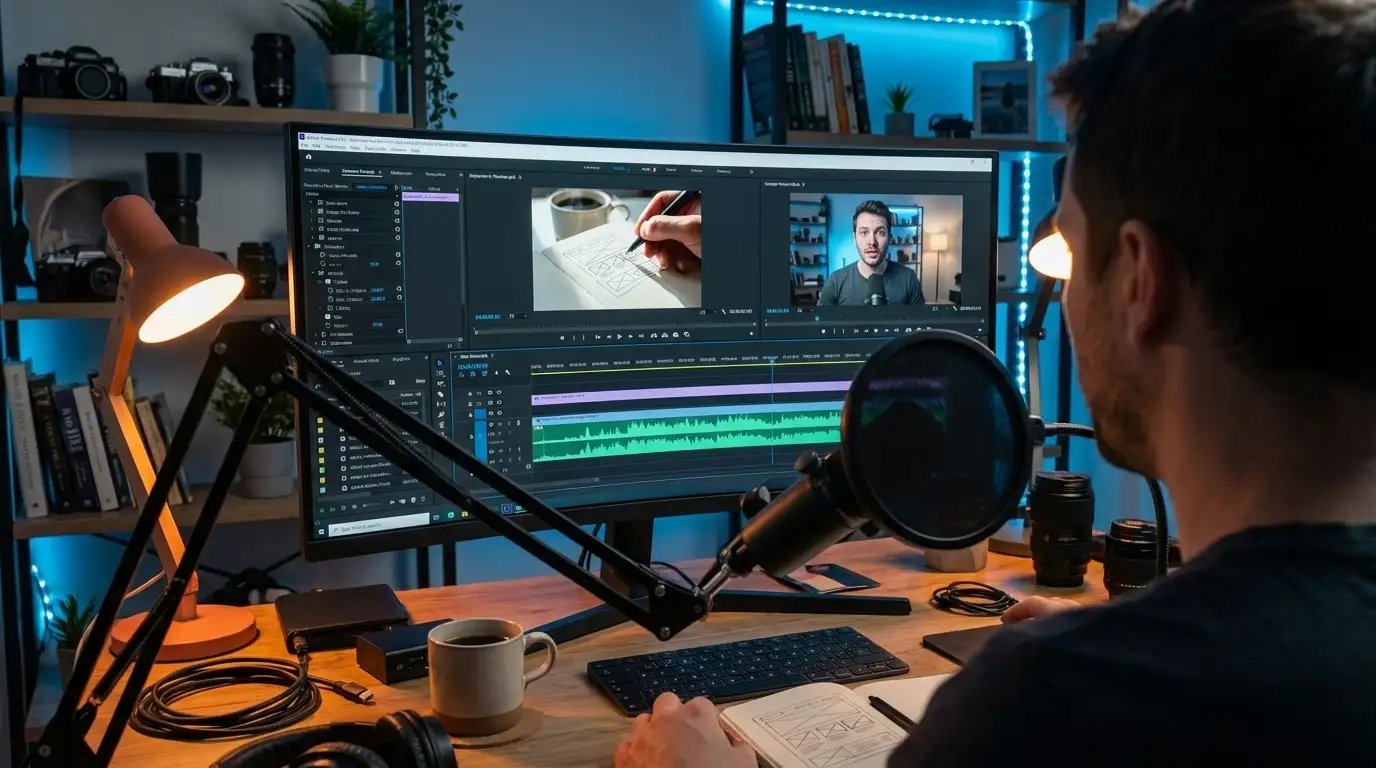
You do not need a Hollywood production. A simple screen recording explaining a complex concept often outperforms a polished marketing fluff piece. Authenticity wins every time.
The "Zombie Pages" Cleanup
One of the fastest ways to improve your site's health is to kill the dead weight.
We call these "Zombie Pages." These are posts you wrote four years ago that get zero traffic, have zero links, and offer zero value.
They are dragging you down. They waste your "Crawl Budget" - the limited attention Google's bots give your site.
The Cleanup Protocol:
- Identify: Use Google Analytics to find pages with 0 visits in the last 12 months.
- Evaluate: Is the content salvageable?
- Action:
- Improve: Rewrite it completely to meet 2026 standards.
- Merge: Combine 3 short, weak posts into 1 massive authority guide and set up 301 redirects.
- Delete: If it is useless, delete it and serve a 410 (Content Gone) status code.
Pruning your site often results in an immediate boost for your remaining healthy pages. Less noise means the quality signals shine brighter.
The Maintenance Routine
SEO is not a "set it and forget it" task. It is a gym membership. You have to show up every week.
Here is a practical schedule to keep your on-page SEO sharp.
| Frequency | Task | Goal |
|---|---|---|
| Weekly | Check GSC Errors | Fix 404s and indexing issues immediately |
| Monthly | Update "Best Of" Posts | Ensure years and facts are current |
| Quarterly | Speed Audit | Keep LCP under 2.0s |
| Yearly | Full Content Audit | Prune zombie pages and merge content |
Frequently Asked Questions
I get asked these questions constantly by clients.
How long does it take for SEO to work in 2026? It is faster than it used to be, but it still requires patience. For a new site, expect 6–12 months for significant traction. For an established site, optimizing existing content can show results in as little as 2–3 weeks.
Does word count still matter? No. "Word count" is not a ranking factor; "Comprehensiveness" is. If you can answer the user's question perfectly in 300 words, do not write 2000. However, for complex topics, it is usually impossible to be comprehensive in less than 1500 words.
Should I use AI to write my content? Use AI as a research assistant, not a writer. AI is great for outlines, generating titles, and finding gaps in your logic. But raw AI output is often bland, repetitive, and lacks the "Experience" signal (E-E-A-T) that Google requires. If you use AI, rewrite it heavily.
Conclusion: The Long Game
If you execute everything in this guide, you will be ahead of 90% of the web.
Most site owners are lazy. They want a magic plugin to fix everything. They do not want to restructure their headers, compress their images, or rewrite their old content.
That is your advantage.
SEO is a competition where the barrier to entry is effort. If you are willing to do the boring, unglamorous work of on-page optimization, you will win.
The algorithm changes every day, but the goal remains the same: Connect the user with the best possible answer. Be that answer.
Now, go open your CMS and start optimizing.
The "1% Optimizations": Advanced Intent Matching
Most people stop at "keyword research." In 2026, that is just the starting line. You need to map your on-page content to the specific micro-intent of the user.
Google classifies intent into four broad buckets:
- Informational (I want to know)
- Navigational (I want to go)
- Commercial (I want to investigate)
- Transactional (I want to buy)
But here is the expert secret: Mixed Intent.
Search for "best CRM software." You will see reviews (Commercial), but you might also see a "What is CRM?" box (Informational).
If your page tries to sell too hard on an informational query, you will fail. If you write a thesis on a transactional query, you will fail.
Action Plan: Before you write your H1, analyze the SERP (Search Engine Results Page).
- Are the top results listicles? You must write a listicle.
- Are they definitive guides? Write a guide.
- Are they product pages? Do not try to rank a blog post there.
Align your format with what Google is already rewarding. This is called "SERP Mirroring."
Local SEO: The On-Page Nuances
Even if you run a national blog, ignoring local signals is a mistake. If you have a physical presence or serve specific areas, your on-page SEO needs to reflect that.
It is not just about slapping "in Chicago" on every header - that is spam.
The Local Content Strategy: Create "Location Service Pages" that are unique. Do not copy-paste the same content for 50 cities.
- Localize the storytelling. Mention local landmarks or specific neighborhood challenges.
- Embed a Map. A real Google Map embed on your contact page connects your digital presence to the physical world.
- NAP Consistency. Name, Address, Phone number. Ensure this footer info matches your Google Business Profile exactly. Even a misplaced comma can cause a data mismatch.
Featured Snippet Optimization (Position Zero)
Ranking #1 is great. Ranking at #0 (the Featured Snippet) is better.
To steal this spot, you need to format your content specifically for the snippet type.
The Definition Snippet: Find a "What is..." question. Answer it in the first sentence of a paragraph. Keep it between 40 and 60 words. Be objective. Start with "X is..."
The List Snippet: Google loves pulling H2s or H3s for list snippets. Ensure your headers are short and punchy.
- Bad Header: "Reason number one why you should consider speed"
- Good Header: "1. Improve Site Speed"
The Table Snippet: We used tables earlier in this post for a reason. Google loves scraping tables. If you have data, do not put it in a screenshot. Code it as an HTML table.

Measuring Success: Beyond the Ranking
You optimized everything. Now what?
You need to watch the right metrics. Ranking #1 for a keyword that brings no conversions is a vanity metric.
The 3 Metrics That Actually Matter:
- Click-Through Rate (CTR): If you rank #3 but have a better title tag than #1, you can steal their traffic. Watch GSC (Google Search Console) for low CTR pages and rewrite their titles.
- Engagement Rate (GA4): This replaced "Bounce Rate." It measures if people actually interact with your site. If this is low, your intro is weak or your page speed is slow.
- Conversion Rate: Are they signing up? Buying? Calling?
The Master On-Page SEO Checklist (Recap)
Print this out. Tape it to your monitor. Do not publish until you check every box.
Basics
- [ ] Primary keyword in Title Tag (Front-loaded)
- [ ] URL is short, clean, and readable
- [ ] Meta Description is catchy (under 160 chars)
Content & Structure
- [ ] H1 tag matches the Title topic
- [ ] Keyword appears in first 100 words
- [ ] H2 and H3 tags used for logical hierarchy
- [ ] Content satisfies User Intent (Format matches SERP)
- [ ] E-E-A-T signals added (Personal stories/Authorship)
Visuals & Media
- [ ] Images are .webp format and compressed
- [ ] Alt text describes the image for accessibility
- [ ] No massive layout shifts (CLS < 0.05)
Technical
- [ ] Page loads in under 2.5 seconds
- [ ] Mobile-friendly check passed
- [ ] Internal links added (3–5 links to other relevant posts)
- [ ] External links added (Link to credible sources)
- [ ] Schema markup is active and valid
Final Words to the Wise
The algorithm is a mirror. It reflects what users want.
In 2010, users wanted keywords. In 2026, users want answers, empathy, and speed.
If you treat SEO as a game of "tricking the system," you will eventually lose. If you treat it as "optimizing for the user experience," you will eventually win. It is really that simple.
The work you put into this checklist today is an investment that pays compound interest for years. Good luck and happy optimizing.